Thursday, June 30, 2011

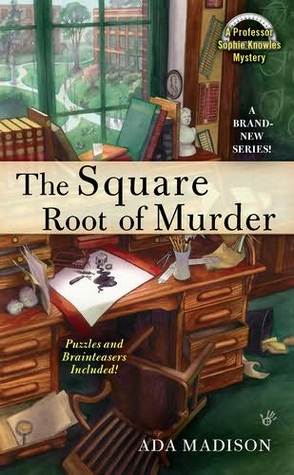
Review - The Square Root of Murder

A brand new series with my favorite kind of heroine - a brainy one!  Ada Madison debuts a new mystery series, although the author has been a popular mystery author under different names (aka Margaret Grace and Camille Minichino.)

Author: Ada Madison

Copyright: July 2011 (Berkly) 304 pgs

Series: 1st in Professor Sophie Knowles Mysteries

Sensuality: n/a

Mystery Sub-genre: cozy

Main Character:  Math Professor Sophie Knowles who creates puzzles for publication in her spare time

Setting: Modern day, Henley Massachusetts

Obtained Through: Publisher for an honest review.


Dr. Keith Appleton, a fellow professor, is widely disliked.  He is caustic, contentious, and mean spirited.  So it doesn't surprise Sophie when her assistant Rachel shares that Dr. Appleton is being difficult about her thesis for him.   When Dr. Appleton is found poisoned and the pages of Rachel's thesis are scattered around him it appears she killed him.  Sophie can't help herself as she starts looking into the case on her own.  What she finds surprises her in many ways.  Who knew Dr. Appleton had a soft side?


Sophie is a character I liked quickly.  She is smart in math but a little sheltered.  She actually concerns herself with caring about people and feels guilty that she felt Dr. Appleton was an ogre.  The story is in first person which isn't my favorite but this one was okay for me.  I liked how her best friend is more a free spirit and not as analytical but their relationship works.  Sophie's boyfriend Bruce seems like a good guy (Medevac helicopter pilot who is a movie buff) who isn't harping about her investigating - a plus in my book.

The plot is good, not overly complicated but there are plenty of suspects and Sophie approaches it logically. The climax had some tense moments as the killer confronts Sophie.  The wrap up was good.  I especially enjoyed the interaction with the Dean (who often censured Sophie) towards the end.  I liked that it is an easy read, inspite of the math, with just enough mystery.  Out of the gate it was a little slow as the reader is introduced to Sophie and the basic situation, but I thought it picked up once the murder occurred. 

I must be a geek myself because I enjoy brainy characters like this.  I enjoyed the Periodic Table Mysteries and was disheartened when that series came to a halt.  I also enjoy mysteries around academic settings with the micro world of campus life. This story brings the campus politics and professor-student as well as professor-professor relationships into the spotlight.  If you enjoy your heroine smart and not-too-complicated consider this mystery.

Now for some geek humor - this is considered a classic.


Bookmark and Share

Monday, June 27, 2011

Guest Post - Elizabeth Mahon

Today Mysteries and My Musings is pleased to welcome Elizabeth Mahon, author of "Scandalous Women: The Lives and Loves of History’s Most Notorious Women."  She is sharing with us information on perhaps the biggest mystery of of the twentieth century.  Welcome Ms. Mahon.

The Disappearance of Amelia Earhart

Amelia Earhart had a knack for making news. From her groundbreaking flight in 1928, as the first woman to fly across the Atlantic to her later solo flight in 1932, Amelia made headlines wherever she went. But no headline was more heartbreaking than the news that her plane was lost. The around the world flight was to be her biggest challenge and her last ‘stunt’ flight, after which she planned to retire from long-distance flying. Earhart was about to turn 40, and thinking about a life on the ground instead of a life in the air. An ill omen seemed to hang over the trip from the start. A botched attempt in March severely damaged her plane. Still determined, Earhart had the twin engine Lockheed Electra rebuilt. "I have a feeling that there is just about one more good flight left in my system, and I hope this trip is it," she said. While the plane was being repaired, Amelia decided to change her flight plan to travel west to east, leaving from Miami instead. The change in plans was due to changes in global wind and weather patterns. When she finally took off on June 1st, with Fred Noonan as her navigator, she left behind crucial equipment, including her parachute, life raft, and wireless antenna.

After numerous stops in South America, Africa, India, and Southeast Asia, Amelia and Fred landed in Lae, New Guinea, on June 29, 1937. Amelia had flown for thirty days and twenty-two thousand miles by that point. There were 7,000 miles to go before she completed her journey. Physically and mentally she was exhausted. The Electra didn’t take off again until July 2, due to adverse weather conditions. Their intended destination was tiny Howland Island, where Amelia expected to refuel. The U.S. Coast Guard cutter Itasca, their radio contact, was stationed just offshore of Howland Island. Two other U.S. ships were positioned along the flight route as markers. Radio contact between Amelia and the U.S. Coast Guard was intermittent. While they could hear her, she couldn’t hear them. The Electra never made it, disappearing somewhere in the Pacific Ocean.

A search began near where they estimated the plane had gone down, 35 to 100 miles northwest of Howland Island. The search effort, authorized by President Roosevelt, cost over $4 million involving ten ships, 66 aircraft, and over 3,000 Navy personnel. It was the most extensive air and sea search in naval history thus far. Neither the plane nor the bodies of Amelia Earhart and Fred Noonan were ever discovered. The effort was discontinued two weeks later on July 19th. George Putnam privately financed another search but finally gave up hope and Amelia was officially declared dead on January 5, 1939. Since her disappearance, a whole cottage industry of myths, urban legends and unsupported claims have sprung up, all of which have been generally dismissed for lack of evidence. Still several unsupported theories have become well known in popular culture.

One theory, and the most plausible, is that put forth by pilot Elgen Long. Long believes that Earhart ran out of fuel just after her last transmission, the ditched plane quickly filling with water and sand. Although she supposedly had a life raft, and emergency supplies, they may not have had enough time to escape before the plane went down. Some believe that Earhart and Fred Noonan managed to land on a remote uninhabited island where they eventually ended up dying of starvation.

The most popular theory is that Amelia was actually on a mission to spy on the Japanese in the Pacific at the request of FDR’s administration. The 1943 film Flight for Freedom starring Rosalind Russell as an Amelia Earhart-like flyer and Fred MacMurray furthered that myth. After the war, both the Japanese and the U.S. Governments denied the rumors. Amelia was known to be a strong pacifist, so the idea of her spying for the military is highly unlikely. She also didn’t have the time or the fuel to make a detour over the Japanese islands, nor would she have been able to see anything of interest, since she would have been in the area at night.

Others believe that Earhart and Noonan were captured and executed when their aircraft crashed on Saipan Island while it was under Japanese occupation. More than 50 witnesses have stated that a tall, thin, short-haired woman dressed like a pilot and a man were seen on the island. In 2009, one of Amelia’s relatives stated that the pair died in Japanese custody, citing unnamed witnesses including Japanese troops and Saipan natives. He said that the Japanese cut the valuable Lockheed aircraft into scrap and threw the pieces into the ocean. Another theory is that Earhart was captured and used for propaganda purposes, serving as the infamous Tokyo Rose whose English radio broadcasts were used as psychological warfare against the Americans. George Putnam, Amelia’s husband, listened to several recordings of Tokyo Rose and concluded that none of the voices matched hers. Still the theory persisted. Even Amelia’s mother Amy believed the rumor. She told a reporter for the Los Angeles Times in 1949 that “Amelia did not die in the ocean. She died in Japan.”

One of the more outlandish theories is that that after the war, Amelia’s friend and pioneering aviator, Jackie Cochran discovered Earhart in Japan, and smuggled her back to the United States. Earhart then was given the new identity of Irene Craigmile Bolam for national security reasons, moved to New Jersey and remarried. This theory was put forth by US Air force Major Joseph Gervais whose research was used by author Joe Klass in the book Amelia Earhart Lives (1970). It was also claimed in the book that her name appeared to be a code which spelled out in degrees and minutes the latitude and longitude of the precise location of the island where Earhart and Noonan crashed after being shot down by the Japanese. Irene Bolam denied being Earhart, and sued the authors. The book's publisher withdrew the book from the market shortly after it was released, settling out of court with her. Bolam's personal life history has been thoroughly documented by researchers, eliminating any possibility she was Earhart.

All these theories (except for the last one) sound plausible in different ways. Unfortunately the mystery of what actually happened to Amelia Earhart will probably never be truly solved until human remains or the plane is found.

Thank you Elizabeth Mahon for that post.  Join Elizabeth at her blog, scandalouswoman.blogspot.com for more fascinating history.  Amelia's disappearance is a mystery that has captivated people around the world still.


Bookmark and Share

Thursday, June 23, 2011

Review - Secret of White Rose

Today I review a historical mystery featuring 1906 New York and the turbulent times of wealth disparity that erupted into violence.  "Stefanie Pintoff is the Edgar® award-winning author of a mystery series where early criminal science meets the dark side of old New York."

If you are looking for the Midsummer's Eve Giveaway Hop, it is the post just prior to this one - just scroll down. 

Author: Stephanie Pintoff

Copyright: May 2011 (Minotaur) 384 pgs

Series: 3rd in Detective Ziele Investigations

Sensuality: n/a

Mystery Sub-genre: Historical Police Procedural

Main Character:  Detective Simon Ziele 

Setting: 1906, New York

Obtained Through: LibraryThing for an honest review

The book opens with Simon Ziele being hustled to a murder scene out of his jurisdication by criminologist Alistair Sinclair.  Alistair had gone to law school with murder victim, Judge Hugo Jackson.  Since Judge Jackson was presiding over the trial of an anarchist Al Drayson his murder is the highest priority.  Drayson planted a bomb to kill industrialsit Andrew Carnegie but ended up killing five innocent people including a child.  The media has whipped the city into high tension and the murder is ratcheting up the tension.  The widow of Judge Jackson insists that Simon be on the case since Alistair wants him.

The widow's demands puts Simon on the bad side of Police Commissioner Theodore Bingham (a historical person who really did command the New York Police from 1906 to 1909.)  Commissioner Bingham rules with a dictatorial style and insists that the anarchists will all be brought to justice for the judge's death.  But Simon and Alistair uncover a secret code in a sheet of music at the crime scene (along with a white rose) which clearly shows it is revenge against the judge.  More murders occur and Simon gets increasingly frustrated as it becomes clear that Alistair is keeping vital information to himself. Then the Commissioner wants to use Simon's tragic past to get to the anarchists.  Both Alistair and Simon are in danger and there are some tense moments.

Simon Ziele is a meaty character with a sad past that has forged his sense of justice while having the compassion to understand it isn't always clear cut in crime.  Simon must face his past and the ghosts that live there during the story which shows how deeply he still hurts.  He is dating Alistair's daughter-in-law (a young widower) Isabella.  His relationship with her is an ever present reminder of her social status and his lack of status. Isabella is great, I immediately liked her as a smart and capable woman who understands Simon well.  Alistair is single minded and privileged and this story shows he is shaken to his core during this case.  Alistair is an interesting character that at turns would draw me in and then make me mad.

The story was a bit slow to grab hold of me.  It took a few chapters before the elements all meshed and I was compelled to read it at every opportunity.  It seemed to pick up speed the further I got into the story.  By the end I didn't want to leave Detective Simon Ziele's world - which is a sign it really came alive for me.  It showed the seamy side of New York's streets, crime, and dirty politics against the backdrop of China Town and the Waldorf Astoria, from the "tombs" where prisoners are kept to the luxury homes of judges it displays NY and all her sides.

The plot was good with several elements coming together.  The climax was gripping and there were several exciting tense scenes that were nicely done.  All story lines were wrapped up well.  I had not read the two prior books in this series and I had no problem picking up significant backstory.  This novel is a little more "real" without being gruesome which I appreciated.   If you enjoy historical mysteries with a little bit of grit this book will please you.


Bookmark and Share

Tuesday, June 21, 2011

Midsummer's Eve Giveaway Hop

We are celebrating Midsummer here at Mysteries and My Musings with a giveaway!  Shakespeare even wrote about it - when we have the longest daylight hours and shortest night.  I love summer, don't you?


To all the participants in the Midsummer's Eve Giveaway Blog hop who stopped by and those who found a new place to visit and hangout - Thank YOU!


If you are joining us as part of the
Midsummer's Eve Giveaway Blog hop, look around and stay for awhile.  We celebrate everything mystery and suspense here - no doubt you can find something of interest!


PRIZE:  One copy of "Nancy Drew and the Women Who Created Her" by Melanie Rehak for two winners.  Read the guest post by Melanie below this post.


Entry for giveaway lasts until June 24 6:00 p.m. (MST).

I will be shipping the books to the winners.

How to enter:

*** First, you must be a member (follower) of this blog.***

All entries are to be in the comments for this post.

I will accept entries for this giveaway Tuesday June 21beginning at midnight (MST) through to 6:00 p.m (MST) on Friday June 24.  
 
I shall notify the winner via the email address you provide to get your mailing address and have the prize sent directly to you.

IF you are a member of this blog, you only need to leave a comment with your correct email.

BECOME a member of this blog if you aren't already and enjoy the celebration of all things mystery and suspense.


Bookmark and Share

Monday, June 20, 2011

Guest Blog - Melanie Rehak

Mysteries and My Musings is delighted to have Melanie Rehak, author of "Girl Sleuth: Nancy Drew and the Women Who Created Her" as our guest blogger.  Her book on the intrepid young detective won an Edgar Award and was named a Best Book of the Year by the Chicago Tribune.  

~ ~ ~ ~ ~ ~ ~ ~ ~ ~ ~ ~ ~

This past spring, Nancy Drew—foiler of plots, possessor of a killer wardrobe, maker of tea sandwiches and above all else, driver of that illustrious blue car, which has morphed over the years from a roadster to a convertible to a hybrid—turned 81. It seems almost inconceivable that our favorite teenaged detective could have been with us for close to a century, but then again, it’s equally difficult to imagine American culture without her. She was the first girl character to head up her own series, the first fictional girl to be as mature, sensible, athletic and smart as her overwhelmingly male children’s book counterparts back in the early decades of the 20th century, and the sleuth that made us all envy her with her adventures, her triumphs over evil, her tight-knit band of friends and, of course, her cute boyfriend Ned, who made a great date but never got in the way of anything she wanted to do.

Unsurprisingly, success came effortlessly to Nancy, though it was something of a shock to almost everyone else. Her first three stories were published on the same day in April of 1930 (in a package that the children’s publishing industry of the time referred to as a “breeder set” because it was designed to get young readers hooked and clamoring for more) and they were runaway hits. The Secret of the Old Clock, The Bungalow Mystery and The Hidden Staircase took Nancy from haunted mansion to creepy cabin to a sinking boat—with a few stops for a nice lunch along the way as well as several blows to the head and a blinding rainstorm. 


Behind the
scenes, things were no less shadowy. Though the books claimed Carolyn Keene as their author, there was no such person, a fact many people are unaware of even today. In reality, Nancy’s inventor was a man named Edward Stratemeyer, and the women who brought her
to life over the next five decades were Edward’s two grown daughters, Harriet and Edna, and a young journalist named Mildred Benson.

Stratemeyer himself was the only person who wasn’t surprised by Nancy’s success. He knew her audience was waiting for her because he got the idea for his “up-to-date American girl at her best, bright, clever, resourceful and full of energy” from his greatest source of inspiration, fan mail from kids. By the time Nancy came along, he was the head of his own company, the Stratemeyer Syndicate, which also put out other indelible series like The Bobbsey Twins, Tom Swift, Bomba the Jungle Boy and The Hardy Boys (who preceded Nancy by three years but were never as popular as she was). His method of working was to write outlines for every book in each series, and then give the writing work to one of his trusty stable of ghostwriters,
which he later edited to ensure consistency. By using a pseudonymous author for each series, he ensured that loyal fans would never know if he changed writers.


And were they ever loyal! Over the course of his decades as a producer of children’s books, he received hundreds of letters from children, and he paid close attention to the enthusiasms and criticisms they shared with him when it came to figuring out what kind of stories to try next. By the mid-1920s, an era of liberation for women, he began to notice that his girl readers in particular were asking for a kind of book he hadn’t considered before: stories in which a girl heroine made her intrepid way through life and did not, in the end, grow up and decide to get married. They had been subsisting on books that were either written for boys or, even if they featured action like The Motor Girls, The Outdoor Girls and the Ruth Fielding series (which concerned a young woman making her way as a film producer in Hollywood) all ended up that way, and they were tired of them. One little girl who was enamored of his Don Sturdy series wrote: “Won’t you please write another two or three about Don and Teddy to satisfy my insatiable love of thrilling and exciting adventure. Please [underlined 8 times] emphatically do not [underlined with a scribble] make Mrs. Sally Sturdy and Ruth so weepy and weak.”

When he dreamed up Nancy, who was originally to be called Stella Strong, his hunch, based on what we might think of today as data from a focus group of children, turned out to be right and created a groundbreaking character who just happened to solve mysteries, too. Nancy, who never aged (with one exception when the driving age was changed from 16 to 18) and never even considered matrimony, was an instant superstar, not least because of her bold independence. Many years later, when Edward’s daughter Harriet was running the Syndicate alone, she reminded herself of this key element: “Must appeal to children. This excludes love element, adult hardships. Marrying off Nancy Drew disastrous.”

And what of Harriet, who ghost wrote many of the Nancy Drew books (and many other Syndicate books as well), her sister Edna, and their writer-for-hire, Mildred? With very little to go on other than their wits and courage, Harriet and Edna took over their father's company when he died suddenly of pneumonia just a few weeks after Nancy’s debut, with Harriet as its public face, and both of them writing of outlines. Edna became a silent partner in 1942, and Harriet forged ahead on her own despite being consistently patronized by men in the publishing business who could not adjust to the idea that a woman was in charge of a million-dollar company.

She had an equally ambitious counterpart in Mildred Benson, who, even after she was hired as a reporter at The Toledo Times during World War II -- a job she steadfastly refused to give up when the men came home -- continued to throw her all into her book writing, which included numerous other series in addition to the Nancy Drew Mystery Stories. These women would have been exceptional even by today’s standards, but in the postwar years, when American women found their choices and salaries abruptly limited, they were nothing short of extraordinary. As their peers dropped not only out of careers but also out of college either to marry or to make sure that they would not be too educated to do so, these two persevered.


Nancy Drew did, too, thanks to the combination of Harriet and Mildred, neither of whom received any credit for her writing efforts until much later. Her good breeding and unwillingness to do so much as kiss Ned Nickerson made her acceptable to newly wholesome 1950's America, even as she continued to outwit everyone. Then, just as the psychedelic 60's threatened to sweep away everything that had come before, including our blue-eyed heroine, the girl detective was anointed by her fans as something much more critical than a series book character with excellent manners and an enviable car:  she was an icon of women's liberation. ''I was such a Nancy Drew fan . . . and I'd love to know how many of us who are feminists right now in our 30's read those books,'' the president of the National Organization for Women (NOW), Karen DeCrow, told The Boston Globe in 1976.

Still, Nancy herself never really changed—she didn’t really have to since she had always been so forward thinking. Though she was being embraced by a new generation, and many details of the books were altered--racial stereotypes, including black characters who spoke exclusively in Southern slave-era dialect, were excised along with clothing styles, appliances and any number of other things that dated the series, while Nancy and her pals began to wear pants and stopped talking about the running boards of cars—the stories themselves remained ageless, existing in a universe untouched by World War II, Korea, Vietnam, the psychedelic '60s and the women's lib movement. Rather than reflecting the times, Nancy provided an escape from them in many ways. Which, if we’re honest about it, is one of the best reasons to read any mystery story, be it Nancy Drew, Mary Higgins Clark, Laura Lippman anyone else. Real life, after all, presents so few opportunities to tie up all the loose ends neatly.


~ ~ ~ ~ ~ ~ ~ ~ ~ ~ ~ ~ ~

THANK You Melanie for that fascinating glimpse into the history of Nancy Drew.  Readers please post any questions or comments you may have.


Here is a short review of one of the early Nancy Drew books.


Bookmark and Share