Monday, November 15, 2021
Author Guest Post - Abby Collette
Monday, June 17, 2019
Author Guest Post - Kate Carlisle
Kate Carlisle is the New York Times bestselling author of two ongoing series: the Bibliophile Mysteries featuring San Francisco bookbinder Brooklyn Wainwright, whose rare book restoration skills uncover old secrets, treachery and murder; and the Fixer-Upper Mysteries, featuring Shannon Hammer, a home contractor who discovers not only skeletons in her neighbors' closets, but murder victims, too. Hallmark Movies & Mysteries has brought the Fixer-Upper Mysteries to TV in a series of movies starring Jewel and Colin Ferguson. A native Californian, Kate worked in television production for many years before turning to writing.
The Bibliophile Mysteries are modern-day murder mysteries that are motivated by a rare book in the care of bookbinder Brooklyn Wainwright. Before writing each book, I do a lot of research and learn fascinating information about the rare book in question, its author, and the times in which the book was published. The most fun part for me is that the themes of the present-day story reflect those of that rare book. For example, while Brooklyn was working on a first-edition of Journey to the Center of the Earth, she found a body in a wine cave (Ripped from the Pages). When she found an 18th-century cookbook and journal, the murder victim was a celebrity chef (A Cookbook Conspiracy).
In my latest Bibliophile Mystery, The Book Supremacy, Brooklyn finds a signed first-edition James Bond novel in a book stall in Paris. She's on her honeymoon with her devilishly handsome British security expert husband, so of course the book she finds has to be The Spy Who Loved Me. Most of the action in the story takes place in a San Francisco spy shop, echoing the fun, fast-paced James Bond themes.
I include as many juicy details from my research as I can without bogging down the story, but invariably there are tidbits I just couldn't work in. Here are 9 things you definitely don't know about James Bond author Ian Fleming. (Unless you're a member of my mailing list, in which case you know a few of these because I like to share interesting research facts in my newsletters. You can join at KateCarlisle.com.)
1. The original M in his life was his Mum, whom he called M. (One senses a snotty teenager's sneer.)
2. John F. Kennedy became a superfan after meeting Ian Fleming at a party in Washington DC. Not long after, JFK listed From Russia with Love as one of his top 10 favorite books for a piece in Life magazine, propelling the James Bond books to the bestsellers lists in the US.
3. Fleming also wrote Chitty Chitty Bang Bang. Clearly, he was always into unique cars loaded with gadgets.
4. The name of the character James Bond came from an American ornithologist because, Fleming said it was the dullest name he could think of. (Why he couldn't just make up a boring name, I don't know.) FYI, "dull" is not the criteria I used when naming Brooklyn Wainwright.
5. Fleming was 31 when he joined Naval Intelligence. His codename was 17F. Which does not possess quite the same cachet as double-0-7.
6. He started writing the first draft of Casino Royale, the first James Bond novel, in February 1952 and finished it in March. I confess, it takes me longer than a month to write a book, which is why I only release two per year. (One Bibliophile Mystery and one Fixer-Upper Mystery.)
7. A true bibliophile, Fleming founded a literary journal exclusively dedicated to book collecting, The Book Collector, which is still published today.
8. Fleming wrote a short story called "James Bond in New York," but instead of doing any top secret spy missions while in the Big Apple, Bond visits his favorite shops and restaurants. (Sounds exciting, doesn't it?) Fleming did this as a concession to American publishers who didn't want to publish his book of essays titled Thrilling Cities because Fleming was somewhat less than thrilled with NYC.
9. Fleming wrote all of his James Bond books at his home in Jamaica, which he named GoldenEye, after one of the operations he oversaw in British Naval intelligence during WWII.
And in case you knew all of those, here's an interesting Fleming-related fact about Sting, the rock-star frontman for The Police: Sting wrote 'Every Breath You Take' while vacationing at Fleming's estate in Jamaica—at the same desk. The lyrics certainly do sound like they're the soundtrack for a spy novel.
Every breath you take
Every move you make
Every bond you break
Every step you take
I'll be watching you
Did you catch "bond" in there? Do you think that's a coincidence? I don't.
To help celebrate the release of The Book Supremacy and its spy shop setting, I'm giving away handy little Bibliophile Mystery magnifiers, with lights and styluses. (Styli?) The giveaway will start on June 13. Join my mailing list so I can email you a reminder when the contest starts or, if you're reading this after June 13, head over to the Secret Room at KateCarlisle.com to see if the contest is still running.
So tell me, was I right when I said you definitely wouldn't know these facts about Ian Fleming? What is your opinion of James Bond? Do you get that view from the books, the movies, or both?
ABOUT THE BOOK SUPREMACY:
In the latest in this New York Times bestselling series, San Francisco book-restoration expert Brooklyn Wainwright investigates a mysterious spy novel linked to a string of murders...
Newlyweds Brooklyn and Derek are enjoying the final days of their honeymoon in Paris. As they're browsing the book stalls along the Seine, Brooklyn finds the perfect gift for Derek, a first edition James Bond novel, The Spy Who Loved Me. When they bump into Ned, an old friend from Derek’s spy days, Brooklyn shows him her latest treasure.
Once they're back home in San Francisco, they visit a spy shop Ned mentioned. The owner begs them to let him display the book Brooklyn found in Paris as part of the shop's first anniversary celebration. Before they agree, Derek makes sure the security is up to snuff—turns out, the unassuming book is worth a great deal more than sentimental value.
Soon after, Derek is dismayed when he receives a mysterious letter from Paris announcing Ned’s death. Then late one night, someone is killed inside the spy shop. Are the murders connected to Brooklyn's rare, pricey book? Is there something even more sinister afoot? Brooklyn and the spy who loves her will have to delve into the darkest parts of Derek's past to unmask an enemy who's been waiting for the chance to destroy everything they hold dear.
~ ~ ~ ~ ~ ~ ~ ~
THANK You Ms. Carlisle for joining us today! I loved the James Bond tidbits. Can't wait to read the book.
Monday, March 25, 2019
Guest Post - Avery Daniels
Avery Daniels is the author of the Resort to Murder mystery series containing Iced, Nailed, Spiked, and a bundle of all three. She is with us today to discuss poison in the mystery genre and her third book. Please welcome her.
In my third Resort to Murder Mystery, Spiked, I delve into poison as a murder weapon. Agatha Christie, the Queen of Crime, used poison as a weapon for over thirty murder victims in her novels. She used Strychnine in “The Mysterious Affair at Styles.” Cyanide was employed most often by Christie and appears in “The Mirror Crack’d from Side to Side,” “And Then There Were None,” “A Pocketful of Rye,” and “Sparkling Cyanide.” Arsenic was used in “4:50 From Paddington.” Christie also used thallium, taxine, coniine, bacillus anthracis, phosphorus, monkshood, belladonna, physostigmine, morphine, and even basic sleeping pills.
That isn’t even touching on the poisonous plants and flowers we often find in our gardens. Besides Poinsettias, there are a number of common plants and flowers that are deadly to animals and humans. This makes it convenient as a murder weapon besides adding an ominous edge to the everyday sight of such lovely flowers as Larkspur, Morning Glory, Lily of the Valley, Daffodil, Azalea, Hydrangea, and Oleander – all of which are toxic to animals and to some degree to people.
As murder weapons go, poison is for the cunning murderer. In my
case I needed a weapon that would throw a timeline completely out the window. What better method than poison which allowed the deadly dose to be administered and then the killer secures an alibi for the actual time of death? Besides there being a wedding my main character is coordinating, with a plethora of flowers everywhere.
But there is the saying that I allow to be repeated in the book that women tend to use poison. What I found was that isn’t entirely or all together true today. Historically poisoning was pretty common and that fact caused kings to employ “tasters” to eat samples of their food to ensure it was safe for the ruler to consume. Even the Greek philosopher Socrates was sentenced to death by hemlock for heresy. The Borgia family of the Middle Ages was notorious arsenic poisoners.
But today, men and women, statistically speaking, use guns primarily for murder. Poison is actually used in one-half of one percent of murders. In a Washington Post article that goes into the weapons that men and women use to kill, they state that women are only seven times more likely to use poison than men even with the overall low occurrences.
So why is it so popular in murder mysteries if not that popular in modern life? Because we often take for granted our food and drink (typically the method to slip a toxic dose) and poison throws tension into the rest of the book as people eye their own meals. Plus the timeline becomes sketchy for pinpointing a killer. And, it is often convenient to acquire without drawing attention, such as purchasing rat poison at a hardware store or picking some lovely plants from your garden, making it ideal for a mystery novel.
Besides, for a cozy mystery it is a neater and cleaner method of death.
Check out Spiked (Resort to Murder III) by Avery Daniels at the following retailers.
Amazon || B&N || iBooks/Apple || Kobo
Follow Avery Daniels at the following:
Goodreads || BookBub || Facebook || Twitter || Newsletter
Monday, March 26, 2018
Author Guest Post - Leeann Betts
Welcome author Leeann Betts to the blog. Leeann Betts writes contemporary suspense, while her real-life persona, Donna Schlachter, pens historical suspense. She has released seven titles in her cozy mystery series, By the Numbers. In addition, Leeann has written a devotional for accountants, bookkeepers, and financial folk, Counting the Days, and, with her real-life persona, Donna Schlachter, has published two books on writing, Nuggets of Writing Gold and More Nuggets of Writing Gold, a compilation of essays, articles, and exercises on the craft. She publishes a free quarterly newsletter that includes a book review and articles on writing and books of interest to readers and writers.
When I sat down 15 years ago to see if I had one book in me, I had no clue where to start.
And now, all this time and more than 30 books later, every time I face the blank page, it’s the same. Where to start?
I’m an avid reader of mysteries, particularly what is now known as cozy mysteries, but at the time were simply called Agatha Christie-like mysteries. If you mentioned the name “Jessica Fletcher”, and said your books were like that TV show, everybody knew exactly what you meant. Amateur sleuth, small town settings that eventually expanded into New York City and major locations around the world, and a personal reason to solve the crime—usually a friend or relative was the victim or the suspect.
That was my basis. But I wanted a main character more like—well, like me. I didn’t have any idea how a teacher thought—Jessica. Or an older woman in a hamlet in England—Miss Marple. Or a retired detective from Belgium—Hercule Poirot.
I needed someone I could relate to. That hadn’t been done to death. No pun intended.
So I went to the library, and started strolling through the children’s section on occupation. And the word Forensic jumped out at me. CSI and NCIS were hot shows at the time, so I picked it up. And that’s where I learned about Forensic Accounting. In the days when I was in college and in the business workforce, we called those guys the Auditors or the Inspectors. They came in and went through all our work to make certain we were doing it correctly. To make certain nobody was embezzling funds. To ascertain clients’ trust funds were secure.
Which opened a whole new world of possibilities for me.
Situations involving money are all over the news. Hardly a day goes by but we hear of someone stealing from a church, a business, a Girl Scout troop. And if you’re anything like me, I wonder how they managed it. How did they go undetected for so many years? What did they use the money for? Was it a one-time thing, they put it back, and hoped nobody would notice? (No Accounting for Murder). Or was it an ongoing theft to line their pockets? (There Was A Crooked Man). Perhaps gambling or other bad choices were involved. (Unbalanced) Maybe organized crime is behind the problem? (Five and Twenty Blackbirds) Identity theft? (Broke, Busted, and Disgusted) Maybe a divorce? (Hidden Assets) Or even counterfeiting? (Petty Cash)
Being a forensic accountant requires specialized training, and involves ferreting out financial information, understanding its implications, and applying that understanding to the situation. It also means preparing reports, spilling the beans on somebody, and testifying in court.
And while a lot of people think accountants are boring, Carly Turnquist is out to prove them wrong.
Just in case you think forensic accounting can’t be an exciting or important job, just remember: Al Capone was imprisoned for tax evasion by the 1930’s equivalent of a forensic accountant.
Connect with Leeann:
Website: www.LeeannBetts.com Receive a free ebook just for signing up for our quarterly newsletter.
Blog: www.AllBettsAreOff.wordpress.com
Facebook: http://bit.ly/1pQSOqV
Twitter: http://bit.ly/1qmqvB6
Books: Amazon http://amzn.to/2dHfgCE
Smashwords: http://bit.ly/2z5ecP8
Tuesday, February 2, 2016
Guest Post - Delia James
We have a new author in the mystery world and I reviewed her debut novel (click here). Find out more about who writes cozy mysteries with a touch of whimsy in the Witch's Cat Mysteries right here.
Hello. My name is Delia James, and I write mysteries. Specifically, I write mysteries with magic and cats with plenty of attitude. This is no surprise to anybody who knows me.
I grew up on mysteries. Summers at my grandmother’s in the country, I discovered her Agatha Christie books and was immediately fascinated by Hercule Poirot. TV was filled with mysteries and we never missed them, Colombo, MacMillan & Wife, McCloud, The Rockford Files, Quincy…and of course I was in love with the Hardy Boys as played by Shaun Cassidy and Parker Stevenson (for the record, I was a Parker Girl, all the way). Of course I could quote Sherlock Holmes, chapter and verse. In college, I got introduced to, and fell in love all over again with, Lord Peter Whimsey.
Despite this, when I started writing, mysteries were not my first choice. I was (confession time) also a major science fiction nerd and it was science fiction I gravitated to first. I don’t regret it at all. Science fiction is fun, and it teaches you a lot about how to build a fictional world along with the characters that fit into it, or don’t. This can be valuable training for a mystery writer who has to construct solid, interesting puzzles the size of small towns, or big bad cities. And of course, along with science fiction, I was also a fan of its sister genre, fantasy, with its elves and hobbits, and witches, and plenty of magic. I learned to read from The Wizard of Oz and had Alice in Wonderland practically memorized.
With all this swirling around in the background, when I got the chance to write a story featuring a witch and a magical cat in New England, you know I jumped at it. And I am having an absolute blast.
First of all, it’s given me an excuse to spend more time in New England, which is one of my very favorite places. I love the landscape, the coast and the rivers. I even love the weather, especially the autumn. I love the old cities and towns and all the history tucked up in their streets and odd (some of them very odd) corners. Of course there are mysteries here. Lots of them, some of them old, some of them brand new.
Cats were another natural for me. I’ve been owned by one cat or another since I was born. From our grumpy old indoor-outdoor tortoiseshell Buttercup, to Isis the Siamese, to our current long-haired gray Buffy the Vermin Slayer, they all at one time or another shared my home, sat on my lap, or curled up on my shoulders, or gotten in between me and…whatever I was doing at the moment. I swear, some of them have in fact been able to vanish and reappear at will, just like Alistair in A Familiar Tail. Of course they couldn’t be kept out of anyplace they really wanted to get into, including the bedroom, the closet, and once, much to everybody’s surprise and embarrassment, the fridge. Again, just like Alistair.
So, like I said at the beginning, I’m Delia James. Welcome to my world!
~ ~ ~ ~ ~ ~ ~ ~
Thank you Ms. James. For the record, I was a Parker Stevenson fan as well. Yay. And I love cats and fantasy as well. I want a vacation during fall in New England and be one of those "leaf peepers" people talk about in discouraging tones. We should do lunch sometime girlfriend! Are you going to Bouchercon?
Monday, December 14, 2015
Guest Post - Joyce Tremel
Today we have the author of the new Brewing Trouble cozy mystery series sharing how she can to write about craft brew beers. I reviewed the debut in this series (click here).
My Path to Writing Cozy Mysteries
If someone had told me even ten years ago that I’d be writing cozies, I’m not sure I would have believed them. Back then, I was the part-time secretary for my local police department and the book I was writing was more of a police procedural, and my main character was an ex-cop who taught martial arts. It was definitely NOT a cozy in any way, shape, or form. It made sense to me to “write what you know.” I knew cops and I knew martial arts—I had a second degree blackbelt in Taekwondo.
Then in 2008, I was let go from that job and I wondered what to do next. Did I find another part-time job? Or should I take the opportunity to write full time and see what happened? Fortunately we didn’t need the tiny bit of income I’d had so I chose the latter and started a new book. The new story featured a police secretary named Irma Jean. She was a bit of a smart aleck. I let myself write without putting a label of “procedural” or “cozy” or anything else on the book. I just wrote the story. When it was finished I sent out queries and an agent liked it enough to work on revising it with me. She had me restructure the book and soon it was ready to submit to publishers.
Except…she dropped a bombshell on me. She was leaving to take her dream job with a publishing company. Eventually I found another agent who started submitting the book. Then she left agenting to go back to school, but the good news was another agent at the same agency took me on. Whew.
To make this long story a little shorter, In Spite of Murder ended up on the desk of an editor at Berkley. She liked the story but the book wasn’t cozy enough for their line. She liked my voice and wanted to know if I’d be interested in writing a cozy.
Well, YES.
I’d been reading a lot of cozies and I realized deep down that was what I wanted to write. That was the genre I had the voice for. I just had to figure out what my book would be about. I didn’t do crafts. I did help hubby with some home improvement type things, but there were already cozies that covered that topic. I tried to think up unusual occupations, but it seemed like most had been done. It finally dawned on me ( I may have been drinking a beer at the time) that there were no cozies with a craft brew theme.
Max O’Hara, my protagonist would be a female brewmaster and I’d set it in my hometown of Pittsburgh. She’d have five older brothers and her dad would be a homicide detective. Her romantic interest would be her childhood crush—the best friend of one of her brothers. I wrote a proposal for what I was calling the Brewing Trouble Series. The proposal included a synopsis of the first book, To Brew Or Not To Brew, plus ideas for following books. I sent the proposal along with the first three chapters to my agent.
And the rest, as they say, is history.
I am so thrilled to be able to finally share this book with readers. I can’t wait for you to meet and spend some time with all my characters. I hope you’ll love them as much as I do. Someone recently asked me if I had a favorite character and I think they were surprised it wasn’t the hunky ex-hockey player-chef, Jake. (An early reader said she needed more Jake in her life, lol.) I happen to adore Elmer, the ninety-two year old World War II vet. He says anything and everything that’s on his mind and doesn’t care who hears it!
I feel very comfortable in the world of writing cozies. Right now, I can’t imagine doing anything else!
~ ~ ~ ~ ~ ~ ~ ~ ~
Thank you Joyce. I loved your new series and the craft beer theme. I love hearing about your path to getting to this stage in your writing career.
Have you seen the 2016 Create Your Shining Year Life & Business workbooks and NEW weekly planner?
Get Free Shipping on all orders over $25 with coupon code FREE25A
Get $10 off orders of $75 or more at EntirelyPets with promo code SAVETEN
EntirelyPets Holiday Store - Find top holiday pet gifts here!
The California Wine Club - Handcrafted, Quality Wines from "Mom & Pop" Wineries. No Bulk Wine.
Get a chapter free when you signup for my newsletter: (click here)
Website
Join author newsletter
Monday, May 26, 2014
Author Guest Post - Kate Carlisle
I have been following the Bibliophile Mysteries for a while now, I have reviewed the seventh book, Cookbook Conspiracy (click here), the sixth book, Peril in Paperback (click here), the fourth, One Book in the Grave (click here), and the third book in the series, The Lies that Bind (click here). But I have not had the opportunity to interview the author Ms Carlisle. So I am tickled to feature a guest post today. Please welcome Kate Carlisle to our little slice of the blogosphere.
Did you watch the Oscars earlier this year? In her acceptance speech for Best Supporting Actress, Lupita Nyong'o thanked her director with a luminescent smile and tears in her eyes. "This has been the joy of my life," she said.
Happiness radiated from her and lifted the mood of everyone who watched.
I could relate to what she was feeling. Writing the Bibliophile Mystery novels has been the joy of my life. I get to immerse myself in everything I love—rare books and bookbinding, history, food, romance, humor, and whodunits. (I was going to say "murder," but saying I love murder makes me sound like a psychopath. I don't love murder, but I've always enjoyed books in which a murderer is caught. Justice… served.) Plus, in writing the books, I get to connect to a community of readers who love the same things that I love, and who enjoy books that both entertain them and make them think.
Joy. Of. My. Life.
A Cookbook Conspiracy was released in hardcover and ebook last year and is now available in mass market paperback. It's a perfect example of all of my great loves coming together in one story. Rare books, history, food, romance, humor, and a whodunit that will keep you guessing until the end.
Bookbinder Brooklyn Wainwright is stunned when her sister Savannah, a chef, asks her to restore the one-of-a-kind journal and cookbook of an indentured servant who came to America before America was a country. In fact, this woman lived during the time of the Revolution, and symbols scribbled in the margins of the journal lead Brooklyn to believe that she may have been a spy.
One of the things I love best about writing the Bibliophile Mysteries is being able to research whatever historical time period captures my fancy, through the appearance of a rare and precious book from that time period. While writing A Cookbook Conspiracy, I delved into the American Revolution, and particularly the fascinating spycraft of the time. Imagine trying to communicate across vast distances in a time of war, before the existence of the internet or telephones or even telegrams. Any message you sent could be intercepted, and the messenger killed. So how do you organize? Secret codes and ciphers were born of necessity.
For the story, I invented Obedience Green, a young English woman who came to America as an indentured servant. Through brief passages from her journal, Obedience comes to life for the reader as a woman who nearly lost her life on the ship to the New World, and went on to become the trusted cook for a British general. But was she using the recipes in her journal to transmit secret messages to the other side? Which side was she fighting for, and how is it possible that a twenty-first century celebrity chef was murdered the very day that this 240-year-old journal came into his possession? Brooklyn doesn't know, but she's determined to find out because her sister is the prime suspect in the chef’s murder. Savannah was discovered with his body… and a bloody fish knife in her hand.
I like my mysteries with a lot of humor, and I hope you do, too. A Cookbook Conspiracy is available now wherever books and ebooks are sold. I'd love to hear from you! You can contact me via my website, www.katecarlisle.com or on Facebook at www.facebook.com/katecarlislebooks.
Have you experienced the joy of your life in your personal or professional life? Share a moment that made you feel happy.
~ ~ ~ ~ ~ ~ ~ ~
THANK You Ms. Carlisle for that delightful post.
Monday, May 12, 2014
Guest Author Post - Sally
Sally Goldenbaum has been so kind us here with an interview (click here) and a previous guest blog (click here). I have reviewed several prior books in the series, including the third book, The Moon Spinners (click here); fourth, Holiday Yarn (click here); the fifth, The Wedding Shawl (click here); and the sixth, A Fatal Fleece (click here). I will be reviewing the newest book in the Seaside Knitters Mysteries, Murder in Merino, later this week. Please welcome back a dear author, Sally Goldenbaum!
“BFFs”
And with each book, we become better friends.
Nell, Birdie, Izzy, and Cass—my friends, my characters, my alter egos. I know how these Sea Harbor women walk, what they eat, how much they weigh, where they went to school, and the first time they had sex. I even know what number they are on the Enneagram chart. They are my ‘stars’ and my muses, my friends.
But often, way too often, I haven’t a clue what they are going to do next—probably just like your own best friend.
And that’s good….and difficult.
Before I sit down to write a new seaside knitters mystery, I
Sometimes they jump right in, like Izzy did in ANGORA ALIBI, (the 7th seaside mystery—the one that just came out in paperback). It took little time for her to share her feelings about pregnancy with me, feelings that moved her to take the actions she did—and that propelled all of her friends (and me, too) into a mytstery, a murder, and gradually the steps needed to solve it.
Or Cass Halloran in A FATAL FLEECE, who showed me she was vulnerable, and not just a crusty lobster fisherman. And Birdie—the 80-year-old matriarch who pulled a skeleton out of her closet in that book, one that changed her life forever. And one that none of us (especially me!) was expecting.
When I began writing the newest Seaside Mystery, MURDER IN MERINO, I was struck by the fact that I’ve known these fine women for over eight years now. They truly are BFFs. To each other. To me. And I hope to you, too.
But sometimes, just like happens in real life, they don’t seem to be around when I need them.
It happened when I began writing MURDER IN MERINO. They
disappeared. It was as if they had taken a vacation without me and didn’t tell me where they were going.
But then one day, suddenly, they were back. Just in the nick of time to lead me around Sea Harbor, into the homes of their friends and neighbors. They introduced me to a new woman in town—a mysterious woman named Jules Ainsley. A woman they took under their wing, even though they weren’t too sure it was a wise thing to do.
And when they decided to explore her past—they took me by the hand and led me along with them. And they didn’t let go, even when it got all of us tangled up in the murder of a bartender—a dear man we were all fond of. But was the mysterious woman who had become involved in the knitters’ lives fond of him?
No one knew, not for sure. But my friends just kept leading me along, and at the end of the journey, they surprised me with what they found. The seed had grown into a plant. A book. Into Murder in Merino.
Yes, after all these years, these women still surprise me. And that’s a good thing. Surprising means they stay fresh, but not completely comfortable. New, but still old friends.
I hope that these friendships deepen with each book, and that their friendship with you deepens, too, so that you’ll keep coming back to sit with them on the deck on in the yarn shop, sharing a glass of wine, a bit of gossip, and secrets of Sea Harbor. I hope they stay fresh for you and for me, unique, but cherished and familiar.
Kind of like a good marriage or partnership. Like BFFs.
~ ~ ~ ~ ~ ~ ~ ~ ~ ~
Thank you so much for a great guest blog Sally! Thank you for returning to our little corner of the blogosphere.
Monday, October 25, 2010
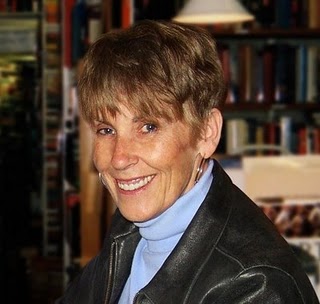
Author Interview - Sally Goldenbaum
We have a favorite author joining us today, Sally Goldenbaum. You can read the review of her latest mystery, Moonspinners, here.
Sally was born in Manitowoc, Wisc, a small city on the shores of Lake Michigan where her father was a shipbuilder. She went to high school in Green Bay, Wisc, a boarder in an all-girls academy, just like her sister, mother and her seven sisters before her had done. Then she went to college at Fontbonne in St. Louis, and graduate school (philosophy) was Indiana U in Bloomington where she met her husband. In between all of that she was a Catholic nun for several years.
One day she was sitting in a sandbox in a park, watching her children play. She was new to Kansas CIty, looking for company. There was another mother there, Adrienne Staff, a transplanted New Yorker. And as those things go, the ex-nun and nice Jewish girl from New York glommed on to each other and discovered they both had a burning desire to write. And so they did. Together. They found a wonderful agent and published (some together, some alone) 25 to 30 novels.
Though Adrienne went on to other things, Sally started writing mysteries some 10 years later. Please join me in welcoming Sally to Mysteries and My Musings!
Usually I have the plot idea first--and that includes the victim--but only after I play with it, turn it around, upside down, maybe even start to write, do I know who the murderer is. Then I throw myself into the writing and sometimes as the story ripens, someone else may emerge as the murderer. Once (only once, thank heavens!) I finished the whole book and sent it off to my editor. She responded quickly that she liked the book except for one thing: the wrong person did the deed. She didn't know who did it, but it wasn't the person I picked, she said. So I had to go back and find someone else. And she, of course, was absolutely right. The book was so much stronger because of her astute observation.
- Do you outline the plot or some variation of that (a little/a lot of detail, a strict 3 act structure etc) before sitting down and writing?
The first thing I do is come up with a synopsis--usually about two pages--that I send off to my editor. Sometimes this doesn't include who did it, and rarely includes how the seaside knitters discover the real murderer (because at that point, I have no idea!). Then I write a first chapter or two to give me a feeling for the story. By that time, I know the following:
• who was murdered
• who did it
• why they did it
I round those things out with other details such as the season of the year, what else is going on in town at the same time (a wedding? a holiday party? a problem in the life of one of the knitters or a neighbor, etc.), and that's it. I don't have an outline, but as I go along, I keep an open file in which I jot down possible scenes and ideas that occur to me as I'm writing.
Long story short: no outline. None. The story evolves as we go along. This can be very frustrating sometimes and I think, "Oh, wouldn't it be great to have an outline and know what's going to happen next?!" But it never works that way for me. The stories evolve as we go along, me and the characters, holding hands and excited to see what happens down the pike.
- What is your process for developing a character? Do you use pictures, a worksheet or just let the character(s) tell you about him/herself as you write?
When I first came up with the idea of the Seaside Knitters series, I needed to know the four main characters well. So I wrote essays about each of them, including where they grew up, went to school, what they were like as kids. How they reacted to happenings in their lives. I thoroughly enjoyed getting to know them this way. I also use the enneagram, an ancient method of personality profiling, in developing characters, and I assign profiles from this system to individuals, which helps me give them a consistent personality. It also assists in learning their vulnerabilities.
Sometimes I do have a person I know, or a public person, in mind to help me with the physical characteristics of certain people, but the characters are never modeled after an actual person, not completely anyway.
I do keep a chart of all physical characteristics. Readers are so sharp--they will catch me at changing hair color if I don't.
- How do you find time for writing, what works for you - and do you have anything special you do before writing, particular music or a special room/location that helps you get in the zone and write?
I had a full-time position while writing the first three Seaside Mysteries (and the Queen Bee Quilters series). Back then, I wrote from 5:30 to 7 in the morning, at night, on weekends, and took some vacation days.
Place? I have a screened-in porch that I write on with a friend (Nancy Pickard) in good weather. When it's too hot or too cold, I head to a coffee shop with comfortable chairs.
If I need a nudge, something to pull me into the mood, I either review what I wrote the day before or pick up someone else's novel, someone I admire, and it almost always draws me to the blank computer screen.
- What is your work schedule like when you're writing and how long does it take you to write a book?
Last year I was able to move to full-time writing and it's a much better arrangement than writing at 5:30 am! Normally I write 5 days a week, starting about 9 and going until 3 or so. The few weeks before a deadline, that goes out the window and I write more frequently, as in 'all the time'. Normally I can complete a book in 6 to 9 months. I have done it in less time, but it's difficult.
- What in your background prepared you to write mystery novels?
It sounds fabricated because everyone says it, but Nancy Drew nurtured my love for mysteries when I was young. I have written other novels, but hadn't considered mysteries because i didn't think I'd be good at the puzzle part. Then a friend suggested I help her with a book she was working on, and from her I learned the fine points of writing a mystery--when and how and why to drop red herrings, how a writer need to relate the murderer, pacing, that sort of thing. And I was hooked.
Every job I've ever had, from college teaching to working in public television to editing bioethics journals, involved writing. So that, too, was good background. And lastly, I love being around people--cable repairmen, painters, lobster fishermen, teachers, other writers, my friends and family and grandchildren. And maybe that's the best preparation of all--a love for people.
- How did you get your first break toward getting published? Was it at a writer's conference or mailing a query letter etc?
My very first break was at a writer's conference. There was an agent there who had agreed, as part of the registration fee, to read a couple pages of a manuscript. She gave us (my first few novels were written with another woman) some tips, asked us to send her a few chapters, and shortly after, she was able to find a home for the book (s). I know it's not always so easy. We were very lucky.
Years later, after taking a few years off from writing to edit a journal, that same editor mentioned that she'd be willing to represent the seaside knitters. And once again, she found a very nice home for them!
- What are you currently reading?
I am reading The Room, a haunting novel by Emma Donoghue, Cutting for Stone, and Innocent.
- What would you say is your interesting writing quirk?
Hmmm. Not sure if this qualifies as a quirk, but I have a great interest in exploring the friendship among strong women. I also think I have pretty good insight into what makes people tick. I employ both those interests and skills in weaving the knitters' tales.
- Do you participate in a critique group (or have you in the past?) What are the pros and cons of critique groups?
I've never been in a critique group, though I've taught creative writing in college and we did critiquing there. I rarely show my writing to anyone before it goes to my editor, although I do brainstorm with a friend who is also a mystery writer. My editor is my critique person, in a way.
I don't have anything against, critique groups, though, provided there are rules that keep people from doing damage to one another's writing ego. I think critique groups can provide a structure that makes it easier for writers to keep writing.
Special note:
My next Seaside Knitters book is A Holiday Yarn. It will be in bookstores Nov. 2, 2010. And I am deep into writing the fifth book in the series, A Wedding Shawl, right now.
I love hearing from readers and invite them to visit my website: http://www.sallygoldenbaum.com/
Thank you for a great interview Sally!!
PBS has a new Sherlock Holmes series. It is set in 21st Century London. I have seen the premier episode and I must say I liked it. Here is the PBS website for the new show http://www.pbs.org/wgbh/masterpiece/sherlock/.